Best Link in Bio for Real Estate Agents in Japan (2026)
Tokyo condo prices broke ¥100 million and overseas buyers doubled their share — but Japan's social playbook does not resemble anyone else's. LINE is infrastructure, kakoikomi is now sanctionable, and fewer than 3 in 10 users treat social as brand discovery.
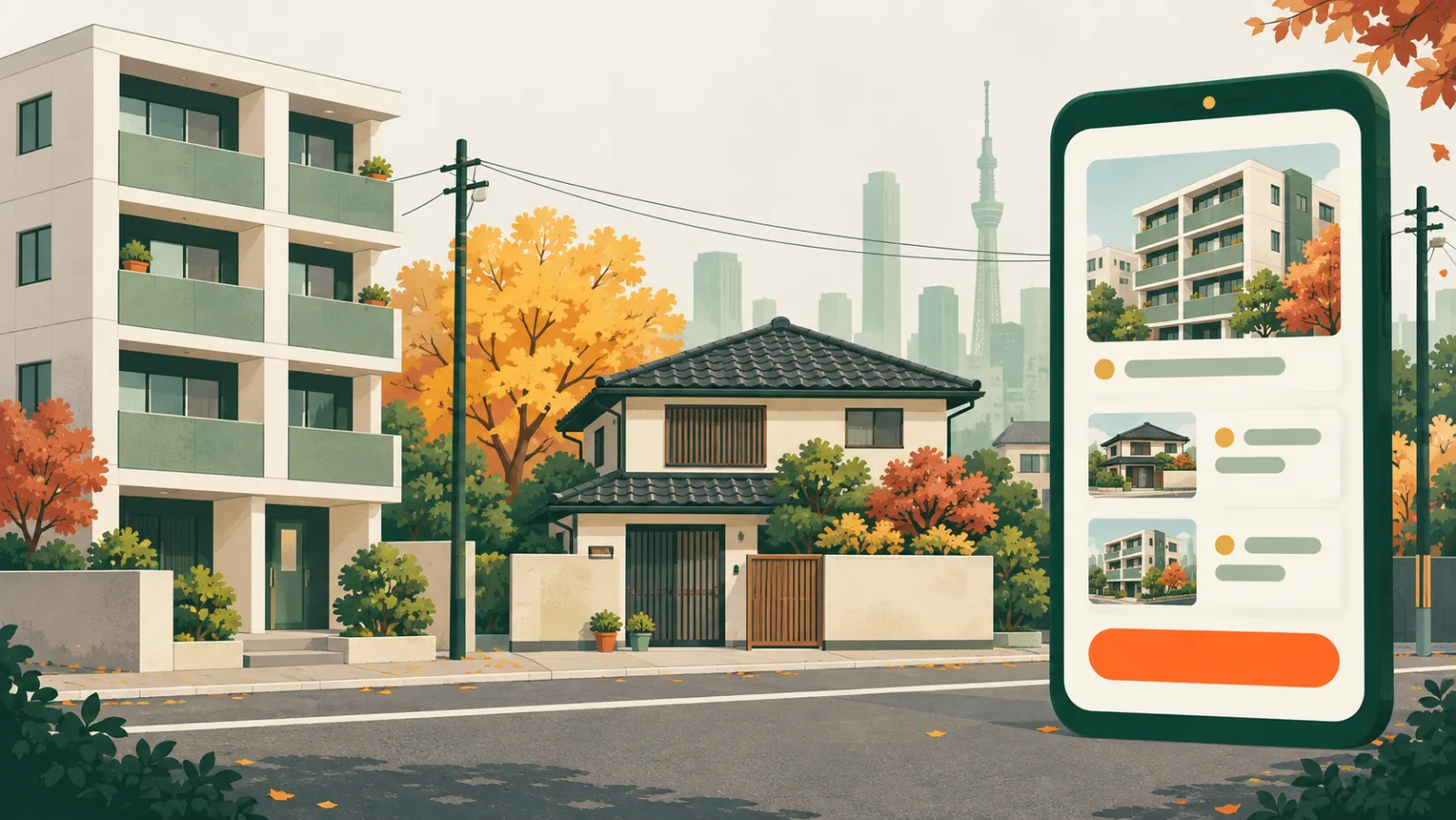
Japan is the market where the standard playbook breaks
Every other guide in this series rests on a shared assumption: buyers form shortlists on social media, so put a good destination behind your bio link and capture the traffic.
Japan is the market where you have to argue for that assumption rather than assume it.
Fewer than 3 in 10 Japanese social media users say they use social platforms to learn about brands, and the average user is active on fewer than 3.5 platforms a month — well below the global average. (DataReportal, Digital 2026: Japan) Discovery runs through search, portals and personal introduction far more than through a feed.
At the same time the market itself has never been more worth competing for. The average new condominium across greater Tokyo passed ¥100 million for the first time in the first half of 2026, hitting ¥101.35 million. In the 23 wards the average reached ¥142.49 million. (Real Estate Economic Institute, via The Japan Times)
So the opportunity is real, but the mechanism is different. This guide is about what actually transfers.
The short version
- LINE reaches roughly 100 million people in Japan and is closer to SMS than to social media — so it is a supported contact route on your page, as a social button and as the Quick Chat action.
- Overseas buyers took 3.5% of new 23-ward condos in H1 2025, more than double 2024. That cohort behaves like every other guide in this series describes.
- Kakoikomi — hoarding a listing to double-dip commission — became subject to administrative sanction from 2025. A public, verifiable listing page is now a trust signal with regulatory weight behind it.
- Your listing page is advertising under the Fair Competition Code: state the transaction type, calculate walking time at 80m per minute, and never call a one-year-old building shinchiku.
The market in numbers
Average new condo price across greater Tokyo, H1 2026 — first time above ¥100M
REEI via Japan TimesNew condo units supplied in greater Tokyo in H1 2026 — second-lowest on record
REEI via Japan TimesThe supply number is the one that should shape your marketing. Greater Tokyo supplied 7,989 new units in the first half of 2026 — the second-lowest figure on record, and the third straight year below 10,000 in a half. Savills reports that 73% of condominium developers say they are struggling to procure land at feasible prices. (Savills, Tokyo Residential)
In a market with scarce inventory and rising prices, the competitive pressure moves off price and onto access and trust. Whoever a seller believes will market the property honestly gets the mandate. That is a very different job from out-shouting rivals on a portal.
Two audiences, two completely different funnels
The single most useful thing to understand about marketing property in Japan is that you are serving two groups whose behaviour barely overlaps.
| The domestic buyer | The overseas buyer | |
|---|---|---|
| Where they search | SUUMO, HOME'S, at home; Google and Yahoo! Japan | Instagram, YouTube, English-language agency sites, referral |
| Attitude to social | Entertainment and contact, rarely brand discovery | Primary discovery channel, exactly as elsewhere |
| Preferred contact | LINE, then phone | Instagram DM, email, WhatsApp, booking link |
| What convinces them | Licence, brokerage, honest disclosure, station distance | That you are real, verifiable, and speak their language |
| Decision speed | Deliberate, portal-verified | Often faster; frequently cash |
Note what this means. The playbook in our USA and Dubai guides — reel to property page to instant enquiry — maps almost perfectly onto your overseas buyer and only partially onto your domestic one.
That is not a reason to skip it. Overseas buyers more than doubled their share of new 23-ward condos in a single year, to 3.5% in H1 2025, and Savills found more than 60% of surveyed developers sold between 20% and 40% of new units in Minato, Chiyoda and Shibuya to foreign buyers. Roughly ¥1 trillion of foreign capital flowed into Japanese real estate in H1 2025. This is the fastest-growing, least-contested segment of your market, and it is the one that behaves the way social-first marketing assumes.
LINE is the contact layer, not a channel
LINE has roughly 100 million monthly active users in Japan — about 81% of the population — with a usage rate around 92.5% across every age group. Among people aged 60 and over, LINE usage went from 11.3% in 2014 to 91.1% in 2024. (LY Corporation and MIC White Paper data, compiled by Silkdrive)
It is not a social network in Japan. It is the contact layer, the way SMS and email are elsewhere. A Japanese seller in their sixties will expect to reach you on LINE.
One decision to make deliberately: the Quick Chat button is a single choice. If your book is mostly domestic, LINE is almost certainly it. If you are chasing overseas buyers, WhatsApp or a booking link may convert better, and LINE still sits on the page as a social button — it just is not the primary action.
Kakoikomi: why a public listing page now carries weight
This is the part of the Japanese market that has genuinely changed, and it turns transparency from a nice gesture into a differentiator.
Kakoikomi (囲い込み) is the practice of a listing agent withholding a property from other agents — not registering it on REINS, or registering it and then falsely telling enquiring brokers it is "under negotiation" — so the agent can find the buyer themselves and collect commission from both sides.
Both sides. Commission in Japan is capped at roughly 3% plus ¥60,000 plus tax per side, so on a ¥50 million property the difference between honest brokerage and a manufactured double-sided deal is roughly ¥1.56 million versus ¥3.12 million.
Here is the marketing consequence, and it is the strongest argument for an owned listing page in this market.
A seller choosing between agents in 2026 has been told to check whether their property is genuinely being advertised. A public page carrying the property, updated, timestamped and linkable — one you can send in a progress report and the seller can check themselves at any hour — is direct evidence that you are doing the opposite of kakoikomi. Most agents cannot produce that on demand. You can make it a standing part of your listing presentation.
What earns the mandate in Japan
- A public page per property the seller can open themselves, any time, as proof of active marketing
- Nearest station and walking minutes stated correctly for every line — the first thing any Japanese buyer looks for
- Your takken licence number and brokerage name on the page, since buyers here genuinely check
- Area in m², with layout described the way local buyers read it (1LDK, 3LDK)
- Languages you actually work in, which is the first filter an overseas buyer applies
- A LINE button, because that is how domestic buyers and sellers expect to reach you
What quietly costs it
- A bio link pointing only at a portal profile, where you look like every other brokerage
- Marketing claims to the seller you cannot evidence when they ask
- Walking times estimated by feel instead of calculated at 80m per minute
- Calling a building shinchiku when it no longer qualifies
- Omitting the transaction type, which is a required disclosure, not a formality
- Assuming an overseas buyer knows that foreigners can own land outright in Japan — most do not
Your listing page is regulated advertising
Japan regulates property advertising unusually precisely, and the rules apply to internet advertising by name.
The Fair Competition Code on Real Estate Advertising (不動産の表示に関する公正競争規約) is industry self-regulation authorised under Article 31 of the Act against Unjustifiable Premiums and Misleading Representations. Its definition of covered advertising explicitly leads with インターネットによる広告表示 — internet advertising. Your listing page is in scope.
The provisions that catch people out:
Every listing must say whether you are 売主 (seller), 貸主 (lessor), 代理 (agent) or 媒介・仲介 (broker), using those words. Rule 9(1). It is a required disclosure, and misstating it is separately prohibited.
Walking time is calculated at 80m of road distance per minute, with any fraction counted as a full minute. Measured building entrance to station entrance. Gradients, stairs and level crossings are not considered — and you cannot reuse the nearest station's figure for another line.
'New' means within one year of construction completion AND never occupied. Both conditions. Article 18(1)(1). A year-old unsold unit is not shinchiku.
Article 8 requires advertiser information, location, price and transaction conditions, and transport access to be shown clearly and legibly. This is why your licence number belongs on the page, not buried.
Two of these rules are quietly useful as content. Very few agents explain the 80m rule to buyers, and almost none explain the shinchiku definition. Both make excellent short videos for an overseas audience that has no idea Japan works this way.
Setting up listree for a Japanese practice
Setting it up
Build this for the buyer who cannot walk into your office — the overseas purchaser, the domestic buyer researching at midnight, the seller checking whether you are really marketing their property. The page carries the listing, the licence and the proof; phone and Instagram carry the conversation.
- Step 1Claim listr.ee/yourname
Add your brokerage, takken licence number, service areas and — critically for this market — the languages you actually work in. The licence number drives a verified badge on your public page, which is exactly what an overseas buyer is scanning for.
- Step 2Load listings the way Japan reads them
Set the currency to JPY and the area unit to m². Layout (1LDK, 3LDK), building age, nearest station with correctly calculated walking minutes, and the transaction type in the description.
- Step 3Set Quick Chat to LINE
Save your LINE ID under Connections, then choose LINE as the Quick Chat action so the sticky footer opens an add-friend link. Overseas-heavy books may prefer WhatsApp or a booking link — it is one choice, so pick for the audience you actually want.
- Step 4Use the page as seller evidence
Send the property link in your two-weekly or weekly REINS-mandated progress report. A seller who can open the page and see their property live is a seller who is not wondering about kakoikomi.
Two further notes specific to Japan:
Publish the explainer content, not the listings, to your overseas audience. Given that fewer than 3 in 10 Japanese users treat social as brand discovery, your domestic reach ceiling on Instagram is lower than the equivalent in Dubai or Sydney. The audience that does respond to social is the international one — and what they need is not another tower render. It is someone explaining freehold ownership, the Bank of Japan Form 22 notification that non-resident buyers must file within 20 days of acquisition, why the building depreciates while the land holds value, and what a management fee actually covers.
Track which listings pull. Listing-level analytics tell you whether your Minato content or your suburban Kanagawa content produces enquiries — and, more usefully in this market, give you a number to put in front of a seller who is deciding whether to renew a three-month exclusive mandate.
How the options compare for Japanese agents
| Channel | What it is good for | What it cannot do |
|---|---|---|
| SUUMO / HOME'S / at home | Domestic buyers in active search; the default starting point | Differentiate you; the lead is shared and the audience is the portal's |
| REINS | Legally mandated inter-agent distribution | Reach a consumer — it is not publicly accessible |
| LINE Official Account | Broadcasts, rich menus and the contact layer domestic clients expect | listree links to your LINE, it does not replace the Official Account tooling |
| Instagram / YouTube | Overseas buyers and younger domestic purchasers | Carry a domestic-only book on its own |
| Your listree page | An owned, linkable listing page that proves active marketing and converts overseas interest | Replace portal search demand or a LINE account |
The honest positioning for Japan is narrower than for other markets in this series. This does not replace your portal subscriptions or your LINE account. It gives you two things you do not otherwise have: a destination for the international audience that is growing fastest, and a piece of verifiable evidence to put in front of sellers in a market where the regulator has just made listing transparency a compliance matter.
A 30-day plan
Claim the handle, set JPY and m², add brokerage, takken licence number, service areas and languages. Load your three most active listings with station, walking minutes and transaction type.
Recalculate every walking time at 80m per minute. Check nothing is called shinchiku that no longer qualifies. Confirm transaction type appears on each listing.
Three explainers, in English: foreigners can own land outright; what the Form 22 filing is; why the building depreciates but the land does not. Not listings — mechanics.
Include the live property link in your next mandated progress report and say plainly that the seller can check it any time. Read which listings pulled and bring the numbers to your next mandate renewal.
Frequently asked questions
Is this useful if all my clients are Japanese? Yes, though the emphasis shifts. With LINE as the Quick Chat action, the contact route matches what domestic buyers actually expect. The other half of the value is seller-facing: a live, linkable listing page as evidence of active marketing during a three-month exclusive mandate — which is a stronger argument in Japan than almost anywhere, for the reasons in the kakoikomi section above.
Can foreigners really buy property in Japan? Yes — freehold, land and building, with essentially the same rights as Japanese nationals. No nationality restriction, no quota, no minimum investment, no non-resident surtax, and no visa implication in either direction. Since April 2026 non-resident buyers file a statistical Form 22 notification with the Bank of Japan within 20 days of acquisition; an agent or judicial scrivener can submit it and it does not block the purchase. Explaining this well is some of the highest-converting content you can make.
Are foreign buyers about to be restricted? It is under active discussion. The government has said it is considering measures on speculative short-term transactions as part of a policy framework, and monitoring of foreign investment has been raised at cabinet level. Nothing announced so far bans foreign ownership. Treat it as a live policy risk to watch rather than a reason to avoid the segment, and do not make promises to clients about what the rules will be.
What about akiya? Japan's vacant-home stock is genuinely enormous, and since July 2024 the commission cap on vacant homes and land at ¥8 million or under rose to ¥330,000 plus tax, collectable from both sides, specifically to make these deals worth an agent's time. Akiya generate large amounts of overseas interest and very few completed transactions — the gap is almost entirely renovation cost, financing and administration. If you work this segment, the content that converts is unglamorous: total realistic cost, who can actually lend, and what the process demands.
Sources: Real Estate Economic Institute figures via The Japan Times; Savills Tokyo Residential research; DataReportal Digital 2026: Japan and compiled LY Corporation / MIC figures; reporting on foreign buyer share and ownership rules from Resident.com. Regulatory points summarise the published Fair Competition Code on Real Estate Advertising and MLIT guidance under the Building Lots and Buildings Transaction Business Act. Rules change — verify with MLIT, your prefectural authority, or your regional Real Estate Fair Trade Council. Nothing here is legal advice.